
The REAL Heartwoods Project
- Feb 28
- 7 min read
Updated: May 18
Last update: 1 April 2026
The dream - A forest that grows with the children
Imagine standing at the edge of a small, dense thicket in Graphisoft Park. The trees are young now - barely saplings - but they were planted by the hands of children. Over the next decade, while those same children move through primary school and beyond, this patch of earth will quietly transform into a layered, living, buzzing microforest.
This is the REAL Heartwoods.

Why a forest?
The REAL Heartwoods is built on the Japanese Miyawaki method - a technique developed by botanist Akira Miyawaki that creates dense, native woodland at extraordinary speed. Where a conventional forest might take a century to mature, a Miyawaki forest grows up to ten times faster, is thirty times denser, and shelters far more wildlife than conventional planting. The secret is density: native species are planted three per square metre, in multiple layers, encouraging the trees to compete upward toward the light and support one another in the process.
What grows here gives back in five ways:
💧 Sponge and rain-maker - roots absorb heavy rain before it floods; leaves return moisture to the sky, seeding clouds that help fight drought
🌬 Cleaner air - every leaf filters dust and pollution; in a city shaped by traffic, every tree counts
🌱 Living soil stores carbon - soil holds more carbon than the atmosphere; these roots are building one of nature's most powerful carbon sinks
☀️ Future shade - as these trees grow, they will cool this spot by up to 5°C on the hottest days
🦋 Magnet for life - dense native forests support up to 18× more biodiversity than conventional planting; a whole neighbourhood of birds, insects and fungi is already moving in
On the 60 m² site in Graphisoft Park, 210 native Hungarian saplings and shrubs were planted on 14 March 2026. Now we watch them race skyward.
The result is a climate-resilient green pocket that supports biodiversity and improves the microclimate in a publicly accessible area. It also becomes something equally important: a place where children can learn outdoors in a concrete, local, and measurable way.
Meet the trees of the REAL Heartwoods!
Below are the 12 native Hungarian species planted on 14 March 2026. The selection was guided by our expert partners, shaped partly by what was available - but the guiding principle throughout was clear: all natives, all good for biodiversity, and all suited to growing side by side happily in a dense Miyawaki planting.
One of the fascinating things about the Miyawaki method is its multi-storey canopy - tall trees reaching for the light, mid-layer trees filling in beneath, and shrubs weaving through the understorey. Here they are, from the tallest to the smallest:
Canopy layer (tall trees - eventual height 15–30m)
1. Sessile Oak (Quercus petraea) — One of the kings of the forest. A single mature oak can support over 500 species of insects, birds, and mammals. Its acorns have no stalks — that’s how you tell it apart from other oaks.
2. Norway Maple (Acer platanoides) — One of the first trees to leaf out in spring, with bright yellow-green flowers that appear just before the leaves. Its seeds have little wings called samaras — spin one and watch it helicopter to the ground!
3. Narrow-leaved Ash (Fraxinus angustifolia subsp. danubialis) — A special Hungarian variety — the Danubian ash — that evolved along the floodplains of the Danube and Tisza rivers. It’s perfectly adapted to our local conditions, making it an ideal guardian for this forest.
Sub-canopy layer (mid-height trees - eventual height 8–15m)
4. Manna Ash (Fraxinus ornus) — Unlike most ash trees, this one produces beautiful creamy-white flowers in spring, filling the air with a sweet scent. In southern Europe, its sap was once harvested as a natural sweetener called “manna.”
5. Field Maple (Acer campestre) — The only maple native to Hungary. In autumn its leaves turn a glorious golden yellow. It’s a favourite of aphids — which means it’s also a favourite of ladybirds, who come to eat them.
6. Wild Pear (Pyrus pyraster) — The ancestor of all pear varieties. It can live for over 200 years and its very hard wood was once used to make musical instruments and rulers.
7. Wild Apple (Malus sylvestris) — The ancestor of every apple you’ve ever eaten. Its fruit is small and sour, but foxes, deer, and birds absolutely love it. All our cultivated apples descend from this tough little tree.
Understorey & shrub layer (eventual height 2–8m)
8. Cornelian Cherry (Cornus mas) — One of the first trees to flower each year — tiny yellow blossoms appear in late winter before the leaves, like little bursts of sunshine. The deep red berries are edible and were eaten in Hungary long before oranges arrived!
9. Elder (Sambucus nigra) — A true woodland pharmacy. Its flowers make elderflower cordial, its berries make syrup and jam, and it has been used as medicine for thousands of years. In folklore, an elder tree near your home was said to protect it.
10. Hazel (Corylus avellana) — Squirrels’ favourite tree! Hazel produces catkins in January — long yellow dangly flowers that shake pollen into the winter wind. Its nuts have fed humans and wildlife for thousands of years.
11. Guelder Rose (Viburnum opulus) — Not actually a rose at all! It produces spectacular white flower clusters in late spring, followed by bright red berries that glisten like jewels in autumn. Birds love them, though they’re too bitter for us.
12. Bloodtwig Dogwood (Cornus sanguinea) — Named for its dramatic deep-red stems, which blaze with colour in winter when everything else looks bare. A brilliant wildlife tree — its berries are rich in oils that migrating birds need for their long journeys.

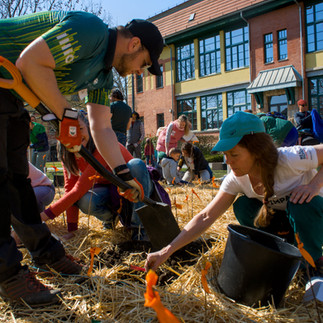


On 14 March 2026, 100 people - children, parents, team and community members - planted 210 native saplings by hand.
A forest as a classroom
The REAL Heartwoods is designed as an educational tool from day one. During planting and aftercare, learning will follow the LEAF (Learning about Forests) cycle.
Planning and planting – community work with children, staff, and families, supported by Graphisoft Park’s gardeners
Observation – monitoring growth and biodiversity through school projects
Knowledge sharing – documenting and communicating what the community learns
The method has a story worth knowing. Akira Miyawaki, the Japanese botanist who developed it, spent a lifetime studying sacred shrine forests - the ancient, layered woodlands that survived centuries of urban growth by staying dense and native. He went on to plant over 40 million trees across 15 countries, inspiring a global movement from India to the Netherlands. Over 3,000 Miyawaki forests now grow worldwide. The REAL Heartwoods is one of them.
The Miyawaki method fits naturally with REAL School's broader educational philosophy: that deep learning happens when children work on real problems and witness real results. Climate change can feel overwhelming, especially for young people. Planting a forest - and watching it grow - is an antidote to that anxiety.
Why a heart-shaped forest?
Stand for a moment at the entrance of what will become a living heart. Here, where the two lobes meet, where the forest forms its gentle V, something rather wonderful is about to unfold. The heart shape serves two essential purposes—one symbolic, the other remarkably practical.
A symbol we can see and share
The heart is perhaps humanity’s most ancient symbol of devotion. By planting a forest in this unmistakable form—visible from above, recognisable at a glance—REAL School creates something that speaks without words. This is love made visible. Not the abstract notion of caring for our planet, but care rendered in soil and saplings, in native species and careful tending.
For students, particularly young ones, this transforms the project entirely. They are not simply “planting trees” - they are growing a heart for the Earth itself. The shape bridges scientific rigour with genuine emotional connection, making ecological restoration not just understood, but felt.
The practical magic of the V
Here’s where design and purpose beautifully converge. Most Miyawaki forests tend toward the circular, the irregular, the organic potato-shape. Nothing wrong with that, of course. But the heart offers something these others cannot: a natural punctum, a point of focus.
At the V - where the two lobes of the heart meet, and the forest opens to its viewers - a rotating sign is planned. One side English, one side Hungarian, each opening with a question in the other language: curiosity makes you flip it, and the answer is the reward. More sculpture than noticeboard, it will be made from natural and upcycled materials, with a repurposed bearing mechanism that gives it a satisfying spin. Text, concept and placement are set; materials and maker are still to be confirmed.
This is crucial. Passers-by must understand what they are seeing - why this dense thicket will grow faster, taller, richer in biodiversity than conventional planting. The V-shaped entrance provides the perfect pedagogical moment: a place where children and adults alike can peer into the growing tangle, watch it transform season by season, year by year.

A living testament
The heart grows. It changes with the seasons, matures over decades, and becomes an ever-richer habitat. Unlike any monument of stone or steel, this symbol breathes. It embodies regeneration not as a concept, but as a living process. REAL School’s heart-shaped forest, then, becomes both teacher and testimony—a beacon of hope, certainly, but also a thoroughly practical design for engaging community, communicating purpose, and nurturing connection with the more-than-human world.
How you can support?
You can
Volunteer to water the trees in summer when the School is on break - email joinus@realschool.hu
Donate via the Dream to Reality Foundation here. Support helps cover the practical elements that make a forest thrive and stay protected in its early years, including aftercare and learning resources.
Our partners

The 10 Million Trees Foundation awarded their National Tree Planting Day grant - Miyawaki mini forest category - to REAL School in January 2026, making the REAL Heartwoods possible.

The project is supported by Graphisoft Park, which is providing the land and participating in long-term maintenance, and by the REAL School community.
Project updates
March–June 2026: Regular watering and weeding with students began. In a Miyawaki forest, this first growing season is the most critical - dense planting means the trees establish quickly, but consistent moisture in years one and two determines how fast the canopy closes. Observation-based learning projects are running alongside.
22 April 2026: On Earth Day, students planted 92 strawberry and lavender plants around the perimeter of the REAL Heartwoods, all donated by REAL School families.


7 April 2026: The protective fence around the REAL Heartwoods is now in place, thanks to the support of the 10 Million Trees Foundation - keeping the young saplings safe as they establish their roots.

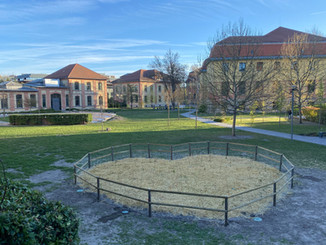


14 March 2026: Community planting day
February 2026: Tools and materials procured, baby trees and site prepared (earthworks, soil improvement, fence preparation), thanks to our partner Garden Futura.
29 January 2026: REAL School was awarded a grant by the 10 Million Trees Foundation to create our very own Miyawaki mini forest.
